Was choosing CSE in 2026 a mistake?
Use this first to separate AI anxiety from the longer decision to learn computing well.
Free career guidance for CSE students
Students can enter CSE for its popularity, earning potential, or promise of opportunities abroad—then discover a field far broader than the few roles they have heard about.
Without early orientation, semesters can disappear into trends and random tutorials. If that feels familiar, you have not missed your chance.
Understand the options, try real work and choose one useful next step—while building the fundamentals and judgment that make AI useful.

“Start small. Future you will be glad you did.”
Your advantage in the AI era
AI is already removing some implementation work, changing junior roles and raising expectations across experience levels. That disruption is real. Now try a harder question: what happens when the software actually matters?
No prediction required. Think through four systems and the pipeline that must produce their future engineers.
Do not look for the answer we want. Try to answer each one yourself.
An AI agent designs and implements software for a spacecraft carrying people or equipment worth hundreds of millions of dollars. The tests are green and the AI says it is ready. Who decides whether the architecture fits, the assumptions are valid, the failure modes are understood and the system is actually safe to launch?
“All tests passed” sounds different when the rollback button is 400 km above Earth.
Who owns the final decision?Software influences a medical decision or controls a medical device. The AI-generated implementation works for common cases. Who investigates the uncommon patient, strange input, sensor failure, missing data or condition nobody included in the happy-path demo?
“Works on my machine” is not a medical certification strategy.
Who proves the edge cases are acceptable?A banking, insurance or FinTech platform processes millions of transactions, claims or decisions. AI produces a feature quickly and explains it confidently. Who verifies security, consistency, reconciliation, permissions, auditability, compliance, failure recovery and what happens when two systems disagree?
“Probably correct” is less charming when the missing zero belongs to your account.
Who understands the consequences?You build a company around business logic competitors do not have. AI can generate and modify the system. Would somebody still need to understand the rules, architecture, security, data, trade-offs and long-term consequences well enough to decide what should actually be built?
Plot twist: now you are the stakeholder.
What expertise would you want in the room?Companies may redesign junior work, apprenticeships and career ladders. AI may help beginners attempt harder work earlier. But judgment still grows through reviewing decisions, debugging strange failures, reading difficult systems, making mistakes and correcting them. If companies keep consuming experience without helping create it, the pipeline eventually becomes their problem too.
SeniorEngineer.exe does not install itself after eight years.
What would a sustainable path from beginner to expert look like?Can AI write the code?
Increasingly, yes—and it will probably get better at it. The harder questions were:
That is why “coding” and “software engineering” are not perfect synonyms.
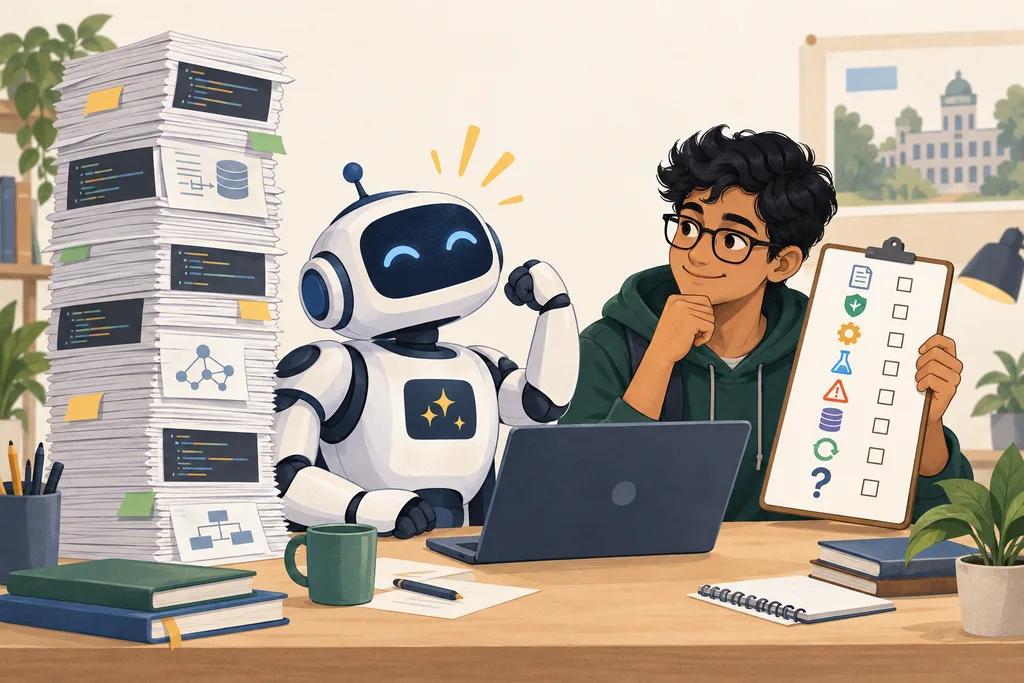
AII generated 8,742 lines and all tests pass.
EngineerNice. Why does the payment service need permission to delete users?
AI…excellent question.
Frame → Verify → Own
Can you explain the real problem, constraints, users, data, risks and definition of “done” before asking AI to solve it?
Bad problem definition + faster code = faster wrong direction.Can you challenge a convincing answer with tests, evidence, edge cases, security reasoning and system knowledge?
Confidence is not a test suite.Can you justify the trade-off, explain the system when something breaks and take responsibility for what reaches real users?
Someone still has to answer the 2:17 AM question: “Why did production do THAT?”No role is guaranteed safe, and yesterday's senior skill set is not automatically enough tomorrow. A better question is: what should I become good at as AI keeps getting better at implementation?
Do not train to beat AI at typing code. Train to understand systems well enough to frame the problem, challenge the answer, verify the evidence and own the result.
The future job title may change. The tools will definitely change. The valuable part is becoming someone who can understand, decide, verify and build with those tools.
Continue the inquiry
Some routine implementation and small freelance work is already shrinking. Junior roles, senior expectations, team structures and the cost of continuous AI use are all changing. Examine the evidence and build an AI-resilient practice without pretending anyone knows the final shape of the market.
Evidence behind the deeper guidance: DORA · NIST NCCoE
Your next step starts here
Pick one route. You can change direction later—no quiz, account, or perfect answer needed.
Feeling behind? You do not have to catch everyone. You just need to stop standing still. Make a realistic restart →
Before you choose anything
Your first direction is a draft, not a verdict.
Bangladesh tech leaders & practitioners
Do not make a decision from a headline. Hear experienced local practitioners, leaders and educators—then test each claim against evidence and your own work.
Use this first to separate AI anxiety from the longer decision to learn computing well.
Connect programming practice to understanding, verification and the ability to direct tools responsibly.
The CSE career landscape
Explore different kinds of problems, daily tasks and trade-offs. Open a career that makes you curious—you are exploring, not committing.
Build, test and improve products and the systems behind them.
Make data reliable, useful and available.
Design and evaluate learning systems.
Understand threats and reduce real risk.
Make delivery and operations dependable.
Design electronic systems and connect software to the physical world.
Study the ideas and systems beneath tools.
Connect technical work, decisions and teams.
Try before you choose
Try a safe, 60–120 minute challenge. Check the prerequisites, try the work, and notice what interests you before committing to a longer learning path.
Build, break and explain a tiny API
Try this experiment →Investigate one authorized web-security flaw
Try this experiment →Train a tiny classifier—and challenge it
Try this experiment →Challenge one metric before drawing the dashboard
Try this experiment →Build an evaluated answer finder—not an AI demo
Try this experiment →Threat-model and protect one tiny feature
Try this experiment →A useful loop
Understand → Explore → Compare → Try → Prepare → Adapt
A career roadmap explains what to learn. A goal guide helps you apply it. Choose a learning roadmap · Find a preparation guide
A meaningful next step beats a perfect plan
Give yourself 20 minutes today: open one career, notice what interests you, and pick one thing to try. That is a real start.